The greatest danger to our future is apathy- Jane Goodall
This post is not a compilation of facts about Luna Moths ( Actias Luna), but an unexpected story of hope, empathy, and kindness.
Summer nights in Northeast Pennsylvania are magic. Dark forests glow to life at dusk as fireflies emerge. Evening air is filled with the cacophony of crickets, katydids, and the occasional bullfrog twang. Humidity meets honeysuckle-drenched air, and dew-stained leaves shine under pastel moonlight. Wildlife emerges to forage, and beneath the tree canopy, another creature shakes free from its chrysalis to begin its short-lived but beautiful life.
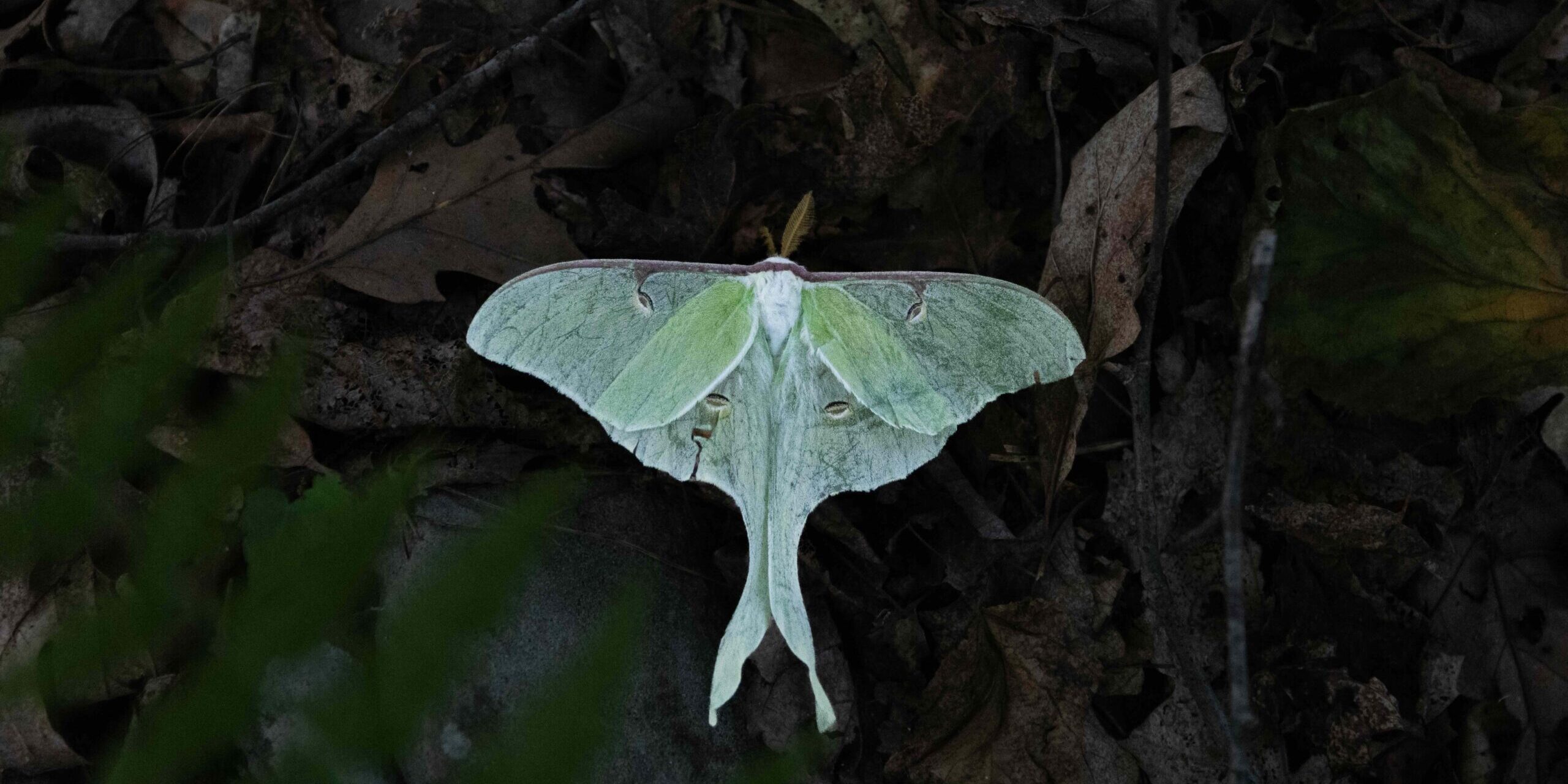
It’s the Luna moth, one of North America’s most beautiful nocturnal insects.
Moon fairy.
Papillon moon.
Moon goddess.
Named after the Roman moon goddess, Luna, this large silk moth is not rare, but a rare find due to its short, nocturnal lifespan.
But one early July morning, I found one, and it ended up being not at all what I expected but just what we all needed.
The Smog
This post is not going to be about climate change, but it will be about kindness. It doesn’t take a scientific degree to know our planet is in dire times. Caring about Planet Earth is an issue that should be everyone’s interest. Why it is not, I will never understand.
It was the morning of the “death smog,” I call it. A raging wildfire was tearing across the Canadian wilderness, devastating hectares of boreal forest and a First Nation community. Troubled thoughts plagued my mind as I sipped my coffee on the patio. Despite the warnings to stay inside (the air quality was “purple,” essentially meaning everyone should stay inside), I stared into the heavy smog that blanketed the Northeast.
It smells like fire, I said to myself. What have we done?
Anyone who feels the planet, I mean feels it, knows how hard it is to emotionally carry on like everything’s fine. Those of us who collected bugs when we were children, played in the dirt, rescued turtles from the road, and cried when trees were cut down to construct some industrial monstrosity are struggling.
That’s when Arwen arrived.
The Rescue
It was as if she fell from the sky. One second there was nothing but a blank pink concrete slab, the next, an unidentifiable green object.
I remember looking down at the patio and thinking, where the heck did that huge leaf come from? Wait, it’s not a leaf; it’s shaking.
Placing my coffee mug down, I made my way over to inspect it.
There she was: a luna moth. It had been only my second time seeing one in my lifetime. Years ago, I spotted one clinging to the window screen on a dark, humid summer night. I remember being enraptured by its beauty.
This one shaking on my patio, however, was in trouble.
I inspected her closely, noting a damaged antenna on her left wing. Several ants were already marching towards her, and her attempt to shake the one on her leg free failed. She fluttered her wings helplessly, and I realized she had lost the ability to fly.
I sighed. I knew nothing about Luna moths. The wildlife rehab place does help injured butterflies, sometimes by even constructing a wing to replace the injured one. Taking a seat beside the moth, I began my relentless internet search about what to do.
“Adult luna moths ( Actias Luna) only live for 3-7 days and lack a mouth or digestive system. They live off the fat stores they build as caterpillars,” the first piece of viable information I found read. The rehab center was not going to take her, and I clearly could not offer her any sustenance.
3-7 days? How sad for such a beautiful creature, I thought.
But I had to do something. Carefully, very carefully, I offered her a leaf to step onto. After some time, she did, and I placed her on a shaded tree in my yard.
When I returned from work that evening, I almost didn’t check to see if she was still there.
Almost.
Moth or magical fairy?
For two days I checked on her, and for two days the Luna moth remained on the ground, untouched but still alive. The fact that she was untouched amazed me. My yard is full of moth predators. Everything from snakes to bats to birds to beetles, spiders, and chipmunks.
How?
“Maybe you found a fairy, and she’s not a moth,” joked a good friend.
Perhaps, but the more reasonable explanation is that Luna moths have an entire arsenal of defenses built right into their anatomy!
- Those ethereal spots on their wings? Eyespots used to deter predators.
- That seafoam green color? Used to disguise themselves as leaves to blend into the tree canopy.
- Detailed scales on their wings? They can actually slide off to evade predators like spiders and mice.
- Those really cool twisty long tails? They can distort bat sonar!
It was day three, and I was already really impressed with this little green fairy. But what now? How much do I intervene, and do I at all? If she is left there, she would inevitably starve to death, the sad but natural reality for a luna moth who completes their entire life cycle.
There was nothing I could do.
But then the storm came.
Intervention
Ethics has been a hot topic of discussion between a friend and me regarding wildlife photography lately.
Personally, my ethical decisions are based on this: if something feels wrong, it is. And then you don’t do it.
But at what level do we feel something is wrong? This differs from person to person, and I believe it can change over a lifetime as we become more sensitive to nature.
As someone who rescues spiders and puts them outside or holds up traffic to rescue a box turtle from certain death, I am highly sensitive to animals.
So when the weather called for heavy storms and flash floods in my area, my first thought was the helpless luna moth.
I struggled with what to do. I wanted to avoid bringing it into a box or into the house because this would be maximum intervention. It would mean removing a wild creature from the wild, and I hated that thought for her.
So, using camping tarps, I constructed a shelter over her, allowing plenty of room for airflow while providing coverage from the heavy rain. Imagine my coworkers knowing what I am doing with my Saturday. I could hear the conversation in my head.
“How was your weekend?”
“Fun! I saw that new movie and went to a concert at Bethel. You?”
“I constructed a tarp canopy to help an injured luna moth.”
Perhaps I was crazy, but maybe the good kind.
The entire time I was hanging them, her tail was aptly pointed up at me; I learned it is a defensive gesture. For some reason, despite knowing they can’t hear anything, I talked to her through the entire process, wondering if, just maybe, every living thing possesses the consciousness to understand good intentions.
I hoped she did.
When I checked the tarp as the storm began, I was pleased to see it was holding up. But then the winds kicked up. Water ran down the hillside, threatening to puddle right where she was. I stood there watching as she cleared her one good antenna and struggled to step away from the incoming water.
She had no way of escaping it. Luna moths can accept light rain droplets on their wings, but a heavy rain or puddle would kill her instantly. Usually they would seek shelter under a tree branch or large leaf, but she couldn’t fly.
“That’s it,” I said. “You are coming with me.”
Seconds later, I was running up the hill with a box, and that’s when the Luna moth became known to me and everyone else I told, as Arwen.
A home for Arwen
Arwen survived the night in an open box on my patio. The next day I drove over an hour to pick up a butterfly enclosure from a good friend. If she was going to live a few more days and I was going to keep her, it was only right to build a proper habitat.
The butterfly enclosure featured two branches; one was tall with many leaves to provide shelter, and the other would be placed on the ground since she lacked the ability to climb or cling. I lined the box with a towel and inspected each branch carefully for any pests.
Luna moths like birch, willow, white oak, hickory, and black walnut, and I did my best to fill her habitat with these.
As the days passed, I spent a lot of time observing her. She didn’t move much besides the occasional belly pump and wing flutter, but during this time I read up on everything I observed.
A few behavior facts about Luna Moths:
- Luna moths ready themselves to fly by warming up their wings. They do this by pumping heat stores from their abdomen.
- The female luna moth is relatively inactive. Her main job when she emerges from the chrysalis is to attract a male. She does so by pumping out pheromones, which a male can smell for up to two miles away! I also read five miles and possibly even twenty!
- Once they mate, which can be a 24-hour affair, the female lays up to 200 eggs on the underside of a leaf. Luna moth caterpillars feed for 3-4 days on hickory, sweet gum, or walnut. They then spin a cocoon ( inside a fallen leaf) and either emerge as an adult moth in 3 weeks or overwinter in their cocoon.
- The sex of an adult luna moth is determined by the size of the antennae, with males sporting bushier, plumper antennae than females. Two people regarded as moth experts said they could not determine whether Arwen was definitely a female or a male. At first I thought female, then male, then I decided whatever she was, she was beautiful regardless.
For two nights, Arwen lived in her enclosure on my patio. I delighted almost everyone I knew with pictures, video clips, and amazing facts about Luna moths.
But the days were passing, and I knew it was almost time to say goodbye.
Arwen’s final night
There are certain indigenous tribes who believe in kinship with species. To them, nature is not to be exploited, but part of a reciprocal relationship.
Somewhere along the line, this has been collectively lost. Instead of reciprocity, we have exploitation. Instead of kinship, we have hierarchy.
But for many of us, that is not the case.
If you read my article about my stance on whaling, you learned how I view nature. Everything, from the toad beside the stream to the majestic whale, deserves a life of freedom.
Arwen’s situation saddened me, not because I knew she would die soon but because she deserved to be free, floating through the forest among the fireflies and honeysuckle, bestowing her hard-earned beauty on anything that laid eyes upon her; not in an enclosure on my patio.
I wonder if it was the polluted haze that had knocked her down. Or a bright artificial light on someone’s house. Or something, anything we did wrong. That is what makes me sad.
During my research, I learned that Luna moths have this incredible ability to navigate by distant ambient light like the moon and stars. So for her last night, I raced home to remove her from her enclosure. The air had cleared, and despite the distant rumble of thunder, there was no rain. My Instagram feed was filled with content about it being National Moth Appreciation Week. How fitting.
Gently, I removed her from her enclosure and placed her outside where she belonged; one last time to be part of the night.
In my research, I read that the main purpose of an adult luna moth is to procreate. But this was not true.
For her short period of time with me, Arwen taught me so much.
She taught me that every act of kindness, no matter how small, matters. She taught me that every creature, no matter how small, deserves a second chance.
She awed me with her beauty and her ability to remain untouched on the forest floor.
She taught me to believe in magic.
Luna moths in the mystical world are believed to be spiritual signs of transformation, renewal, and impermanence. I would also like to add that they are signs of hope.
Rest easy, little moon fairy.
If you like to learn more about these incredible creatures known as moths, you can read up on them on the Xerces website here.