The already arduous climb to the cliffs was made worse by the unrelenting wind. I shifted my backpack with false hope that distributing its weight would relieve the knots in my shoulders, but weeks of carrying the thing wouldn’t be undone in a mere minute. After dodging a flock of territorial Arctic terns, I made it to the narrow dirt trail that would lead me to the puffins.
It had been a year since I had set foot on Grimsey, and it still felt as special as it had the first time. When I reached the cliffs, I knelt, letting the pack fall beside me. It was a relief. Settling into the sheep dung-slick grass, I observed the scene before me.
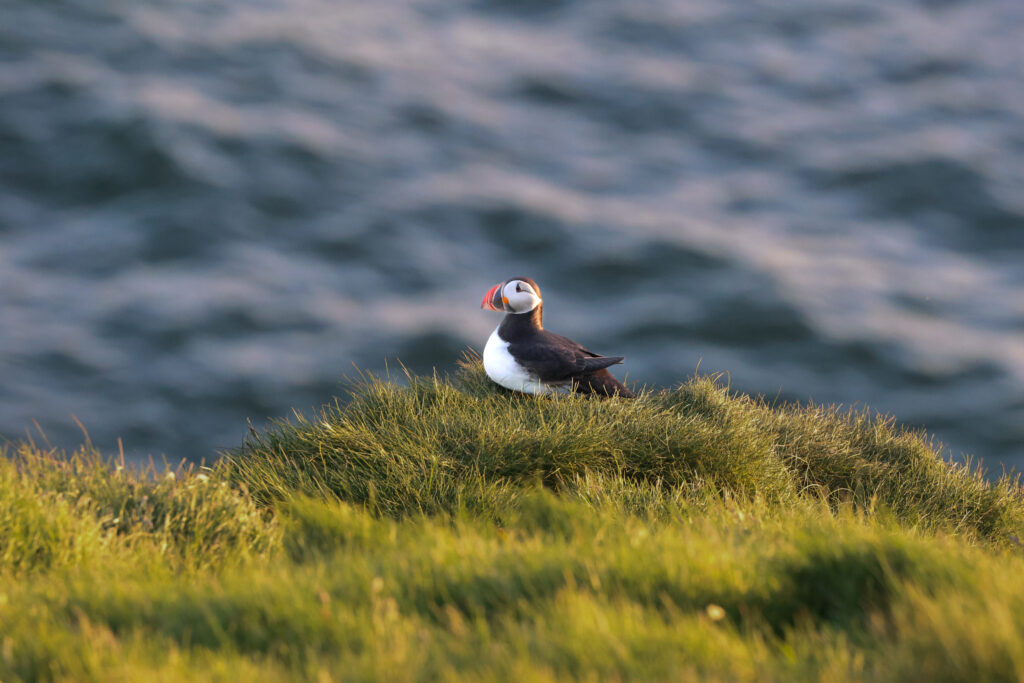
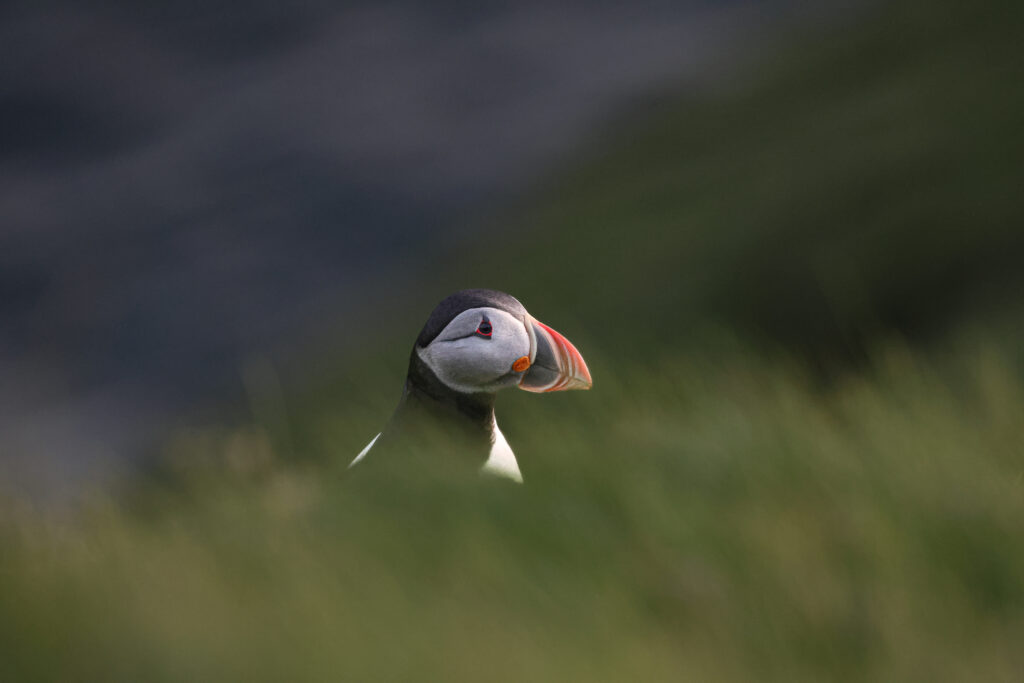
Within an instant, the long journey was worth it. Hundreds of puffins floated atop the deep blue Arctic water. But that wasn’t the real show. Puffins floated beside the cliffs in the high winds, their usual concerned expressions appearing even more concerned.
I took a moment to enjoy the show, which also included soaring experts, Fulmars, and a few Razorbills. The Icelandic wind showed no mercy to its nature, nor its visitors, and today was no exception.
For the next few hours, it would be just me, the floating puffins, and the vast Arctic landscape. Alone on this small, remote island is exactly where I wanted to be.
Grimsey Island
I have been obsessed with puffins since I was a little girl. My grandmother had gifted me a book of poems and one titled “A Puffin and His Muffin,” stole my affection right away.
The first time I ever saw a puffin in the wild was emotional. It was on the southern cliffs of Dyrhólaey, Iceland. A single Atlantic Puffin came fluttering in to meet his mate at their grassy burrow. I cried, I was so moved by their cuteness.
Since then, I have made it a mission to return to Iceland every summer to photograph the Atlantic Puffins as they return for breeding season. I have spent days on Westman Island observing and photographing them, and last year, for the first time, I took the long sail to Grimsey Island to witness one of Europe’s largest colonies.
Grimsey is a small island in the Arctic Circle off the North coast of Iceland. It can be reached by a 3-hour ferry from Dalvik or by plane with Nordlandair from Akureyri.
The first mention of Grimsey in Iceland’s history dates back to 1024 in the text Heimskringla. This tiny Arctic outpost was first inhabited during the Viking age (9th and 10th centuries). Through the years, the people of Grimsey mostly survived off the island’s agriculture, such as fishing and bird life.
Now it has become a tourism spot for those willing to undertake the journey.
Grimsey, located approximately 20 nautical miles off of Iceland’s north coast, is only 5.5 km long and 105 m above sea level at its highest point. It is currently owned by Akureyri and its inhabitants. The current population of Grimsey is around 50-90 inhabitants (2021).
Due to Grimsey’s far-north location, the island experiences a more dramatic light change than the mainland. During the winter, Grimsey has only two hours of daylight, and in the summer months experiences 24 hours of daylight, allowing ample opportunity to photograph its star resident, the Atlantic Puffin.
The Puffins of Grimsey
Grimsey is home to over one million birds, and the largest proportion of that is the Atlantic Puffin. It is estimated that 100,000 – 300,000 puffins return to Grimsey for the breeding season, which begins in late April.
The island’s rugged and grassy cliffsides make it ideal colony location for puffins who nest in the ground in burrows that they often return to year after year.
Puffins are typically solitary birds, spending the winters paddling the North Atlantic alone. They reunite with their lifelong mates every May in their respective breeding grounds where they spend the summer as a colony.
Puffins mate for life, and the male typically returns to their burrow first to tidy it up. The first puffins usually arrive on Grimsey in mid-April and stay until mid-August to raise their puffling.
Atlantic puffins have only one chick per season, which they raise together, often journeying 50-100 km one way to get food for. Puffins feed on small fish such as sand eels, herring, and capelin. Due to the ocean’s warming, puffins have to journey even further to hunt now. These realities make them a particularly vulnerable species, and they are now listed as Vulnerable by the IUCN due to population declines.
Puffins are hunted on Grimsey, and do not be surprised if you see “Puffin Breast” on the menu ( something I do not support), but this has been a Grimsey tradition since its establishment. I am hopeful these laws change as the puffin status is changing.
For puffin viewing you can simply walk around the island’s perimeter although I would strongly advise keeping your distance by the cliffs for two reasons:
- Puffins can be timid in these areas and are even more sensitive during the breeding season. Every flight expends energy. Please be aware of your proximity and avoid disturbing them as much as possible. Your best strategy is to find a spot and wait. Patience pays off!
- Puffin burrows are affecting the integrity of the ground near the cliffs. Take extra caution and watch your step!
Along with puffins, you will also see Arctic Terns, Common Snipes ( one of my favorite birds in Iceland!), Razorbills, Fulmars, and Golden Plovers. Grimsey, although small and remote, is a birder’s paradise!
It is well worth the journey, and besides the bird life, the light is beautiful. There is something otherworldly about the light in sub-Arctic areas, and Grimsey is no exception. Even on a cloudy night, the light is magical.
on a sunny early summer day, you will be treated to one of the most beautiful sunsets on this Arctic gem.
Photography Tips
I have experienced Grimsey in both sunny, clear conditions and cloudy, windy conditions that I swear wanted to kill me. I can say BOTH are wonderful and offer the photographer a unique perspective on the island’s birdlife.
My suggestion would be to stay at least one night and have a few composition ideas in your mind. Here are a few examples:
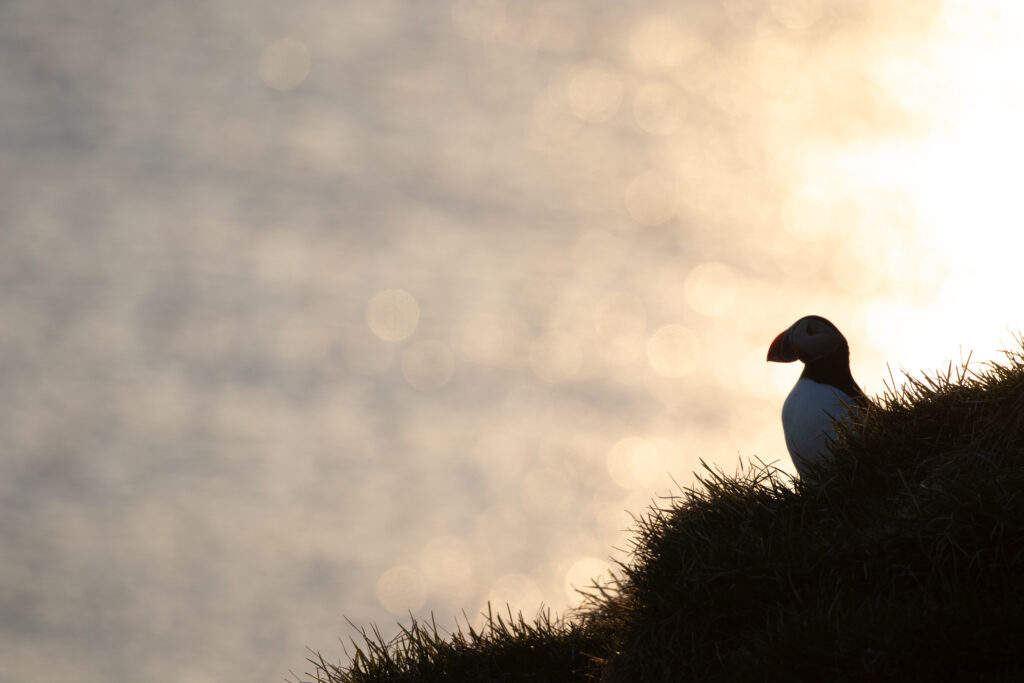
- Puffin silhouette in the midnight sun
- A pair of puffins in the golden light
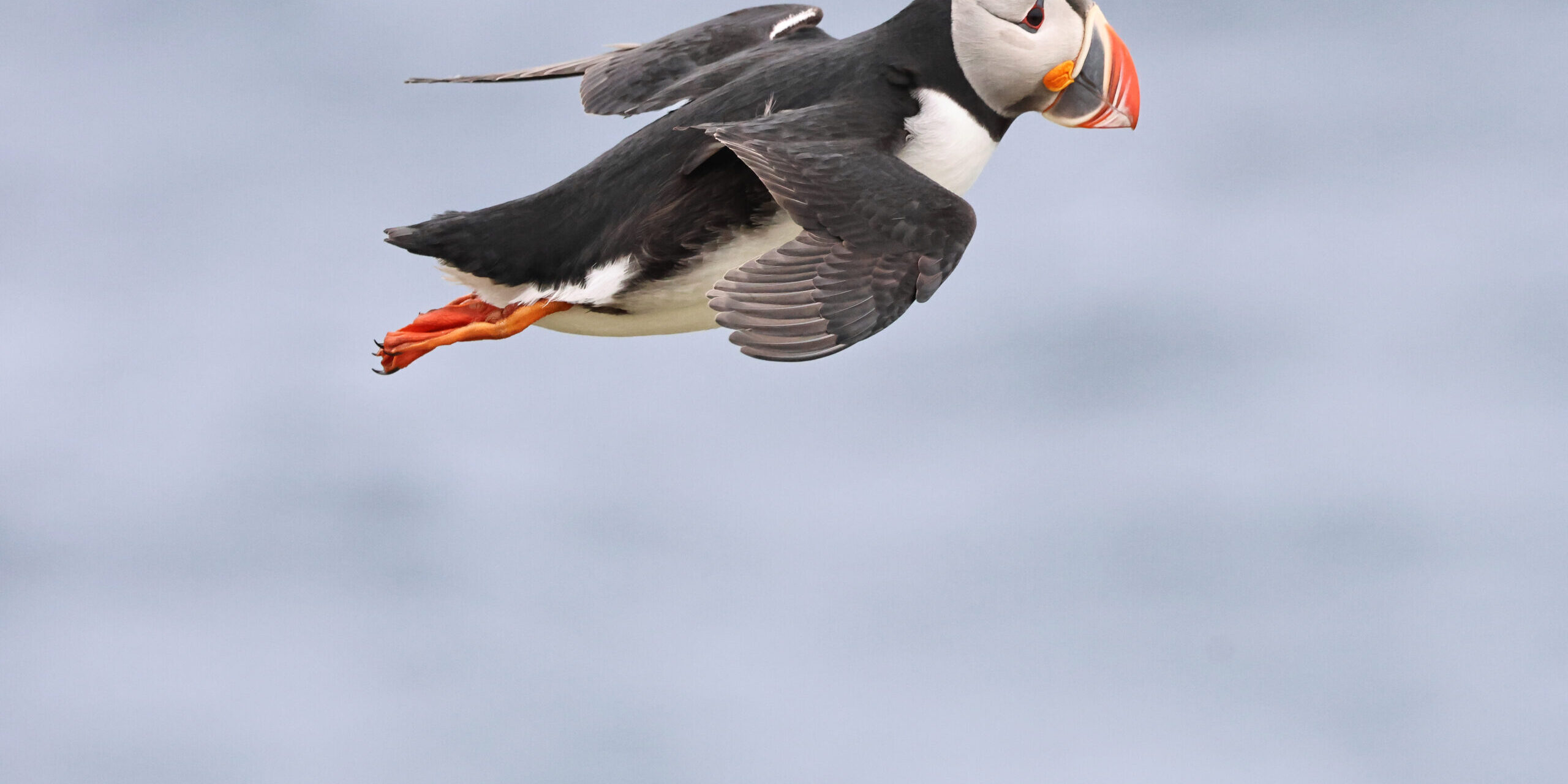
- Puffin in flight. This is a great place to practice this skill, as the island offers ample viewpoints to track puffins in flight
- Puffin in the wind. On a windy day, the puffins float next to the cliffs. This is a great opportunity to get a few shots of the puffin in the air!
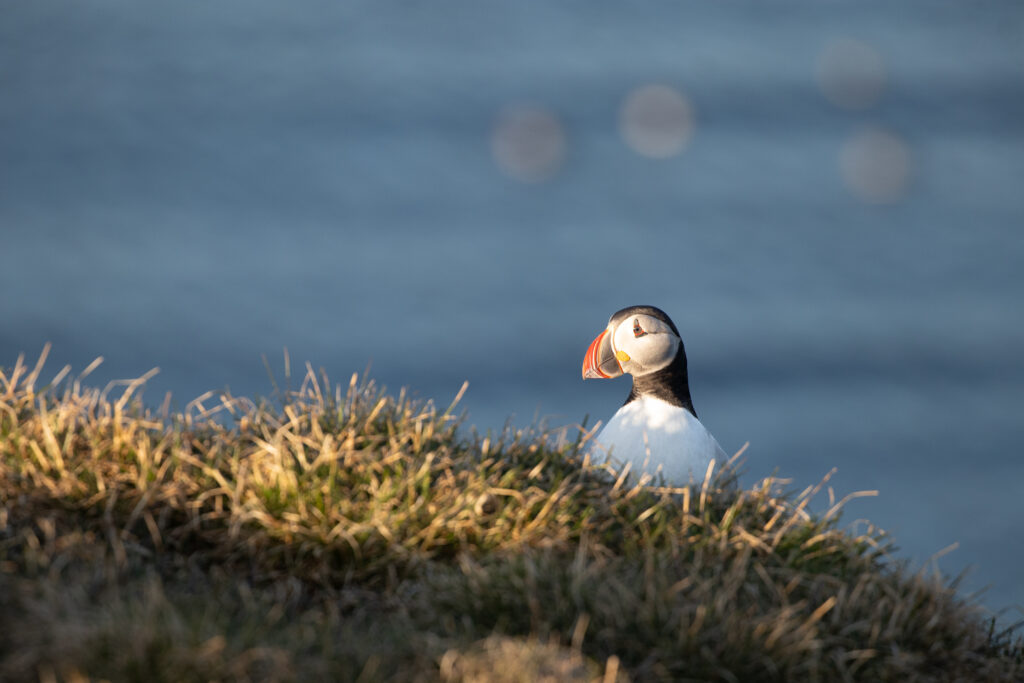
- Puffins framed by grass, cliffs, or flowers.
Or simply, arrive, observe, and let the vastness inspire you!
Before you arrive, use an app like Alpenglow or PhotoPills to determine the direction of light. Remember, it is easier to photograph birds in flight with some light, but it can be done on an overcast day as well.
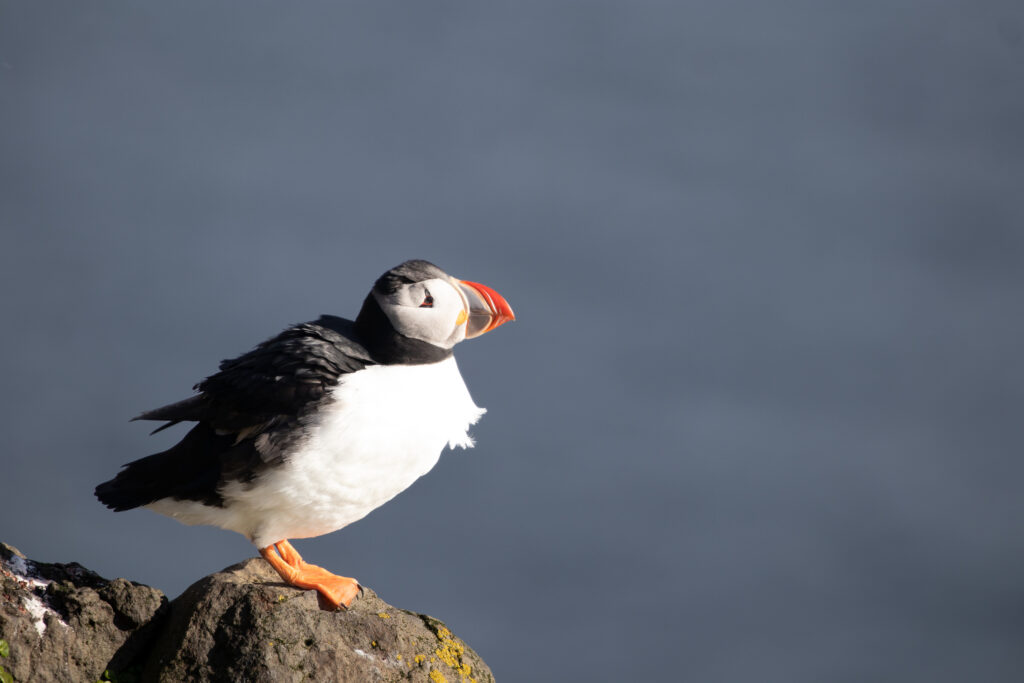
Become very familiar with your camera’s histogram. Because puffins are black and white, it can be challenging to capture the details without overexposing the whites. You may have to adjust this depending on the available light ( overcast versus sunny etc).
Remember to bump up your shutter speed for puffins in flight. I start with 3200 but will sometimes go up to 4000 depending on how fast they are soaring and how much camera shake I am experiencing.
If you take the ferry and arrive midday, use this time to scout the island and get an idea of what you want to do. I don’t shy away from harsh daylight photography because it lets me capture BIFs and practice shots.
What to pack:
- telefoto lens (100-500 mm is ideal) and one wide angle for landscape shots
- memory cards and batteries, charger
- tripod. be sure your tripod can withstand wind or keep your hands on it at all times!
- backpack or waterproof bag for gear just in case
- a poncho
- layers such as merino wool, a waterproof jacket, and pants
- sturdy hiking boots with good ankle support. The terrain on Grimsey is mostly grassy knolls, with some narrow dirt paths but it can get rugged in a few spots.
- Leave the drone at home. Drone flying is prohibited on Grimsey. The Icelandic government just rolled out new drone laws.
- Snacks and food for the guesthouse. The restaurant Krían is open daily for lunch and dinner in the summer months, and the grocery store on the island is open from 3-6 PM on weekdays.
- Remember to pack your sense of adventure and flexibility! Iceland is highly unpredictable, making it challenging to plan, but an adventure for all!
I had planned on a few golden midnight sun shots, but there was overcast for my entire stay. The clouds provided a lovely daytime filter, and the high winds created quite a show of hovering puffins! I was very satisfied with the shots I got and with what I’ll never forget the moments I witnessed.
With the right attitude, you can adapt and still experience something unforgettable!
Reaching Grimsey
There are two options to reach Grimsey.
The first is by way of the Ferry Sævar from the town of Dalvik. If you are renting a car, you can leave it at the ferry port. I had to take a taxi from a nearby town to reach the ferry. The ferry departs Dalvik at 9 AM, and you can view the schedule here.
If you are planning to visit Grimsey to see the puffins, especially for photography, I would highly recommend an overnight stay at Básar Guesthouse. The owner is very hospitable and will even pick you up at the harbor. The guesthouse was spotless, comfortable, and in a great location to access the puffin viewpoints.
The second option for reaching Grimsey is a flight from Akureyri Airport operated by Norlandair. You can reach Akureyri by car or by a flight out of Iceland’s domestic airport in Reykjavik.
The flight schedule can be viewed here.
Need to know
If you choose to take the ferry the sail can be a little rough. If you are prone to sea sickness I would be prepared accordingly or choose the flight. You can also sail in and fly out as most passengers choose to do this!
I chose the ferry every time because I enjoy sailing and the chance to see the humpback whales on the journey through the fjord. You can also see porpoises and observe the Fulmars as they use the wind from the boat to propel themselves forward.
As stated, the weather in Iceland can be unpredictable. I would not rely on a weather forecast a week out from your trip and instead check it the day before, but still arrive prepared for anything!
On occasion, the sail or flights are canceled due to weather or rough seas. Plan some space around your trip so you can reschedule if needed.
The Arctic Circle marker on Grimsey can be reached by hiking north. You can get a certificate stating that you reached the Arctic Circle at the Gullsol guesthouse near the harbor.
Atlantic Puffins are now listed as a vulnerable species by the IUCN, a sobering reality for our ocean life. In the winter of 2025, Atlantic puffins were part of a wreck due to severe storms in the North Atlantic.
As a result, the species suffered a significant population loss, and many European organizations banded together to help the surviving puffins that washed ashore.
With this in mind, please maintain a respectful viewing distance from the puffins and obey the local regulations regarding drone flying.
We need to do whatever we can to ensure the puffins continue to have a place to return to for breeding where they feel welcomed!
In an effort to do my part I have created a reusable tote bag which features one of my favorite puffin photos of all time, as well as a calendar of thoughtfully curated puffin photos!
The profits from both items go towards The Puffin Project in Maine, USA, to support its seabird conservation efforts. You can purchase them here
Enjoy your trip to Grimsey and make sure you take time away from the camera just to observe, be and connect!
Stay tuned to watch the full journey and highlights of my recent birding adventure in Iceland on YouTube!
Goða ferð/ Good journeys
Arielle